

Your entire AR, explained. Not just displayed.
Most dashboards show you numbers and leave the interpretation to you. Invoice Butler shows the work being done, plus an AI summary of every customer: how they pay, what they've promised, what's blocking them, and what happens next.
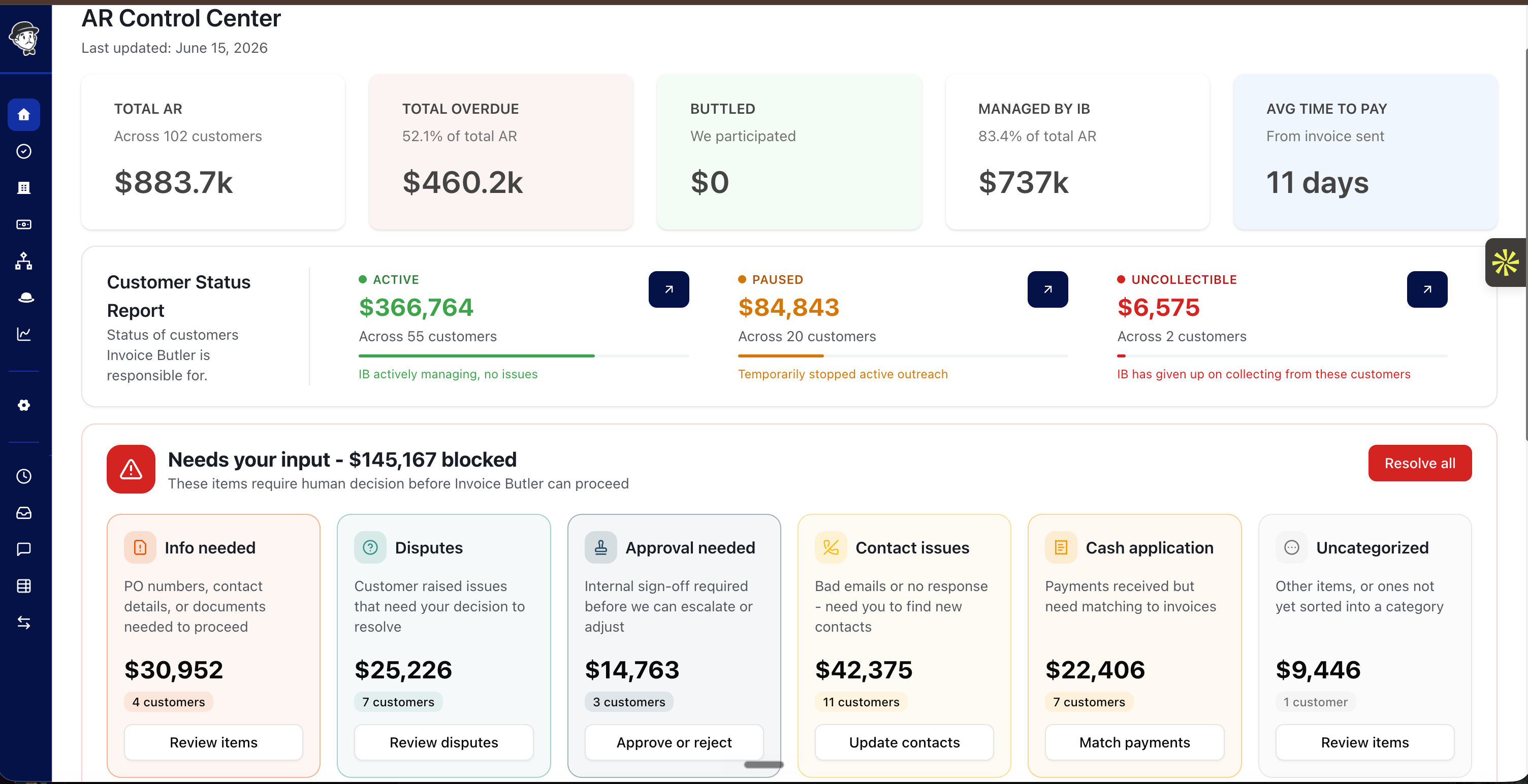
Every customer, summarized. Every number, explained.
Your aging report says 47 invoices are overdue. It will tell you the buckets, the amounts, the days outstanding, and nothing else. Why is Acme at 60 days? Is Globex slow-paying or disputing? Which of these numbers is a process problem and which is a credit problem? The report doesn't know. The answers live in email threads, portal logs, and someone's memory.
Reminder-tool dashboards make it worse by measuring the wrong thing: emails sent, opens, click rates.
That's activity, not understanding, knowing a customer opened your third reminder tells you nothing about whether the invoice is blocked on a missing W-9. And on a lean team, nobody has time to maintain the account narratives that would actually explain the aging.
So the knowledge gets reconstructed live, in meetings. The CFO asks "what's happening with Acme?" and someone spends twenty minutes on archaeology, for one account, again next week. Multiply by every account and every week: that's the real cost of dashboards that display instead of explain.
Every customer, summarized. Every number, explained.
Because Invoice Butler does the collecting, it can explain the state. Every account carries a living AI summary, payment behavior, promise history, open blockers, conversation tone, and the recommended next move, updated as things change. Above that, portfolio analytics that mean something: aging where every line knows its blocker, committed cash by week built from real customer commitments, and risk flags raised before an account becomes a write-off. You read answers, not exports.
What the Butler handles
AI customer summaries
Every account condensed: payment history, current blockers, outstanding promises, conversation tone. Read in ten seconds what used to take an afternoon of archaeology.
The "why" behind every invoice
Statuses describe the actual state — "Blocked on PO amendment," "Promise due Jun 14," "Portal approval pending" — not "Reminder 3 sent."
Risk analysis & early warnings
Broken-promise patterns, slowing payment behavior, and gone-quiet accounts surfaced early — while they're still recoverable conversations.
Committed-cash forecasting
Expected payments by week, built from actual customer commitments and scheduled portal runs — not aging-bucket guesswork.
Aging that explains itself
Every line in the aging carries its blocker and next action. The board slide assembles itself.
One dashboard, everything
Every open invoice, every follow-up, every payment in one place. No status updates needed — from anyone.
Live in under a week
The butler works your AR
Outbound, replies, portals, promises, escalations — every collections action flows through one system. That's what makes real summaries possible.
AI condenses every account
Conversations, commitments, and blockers are distilled into a living summary per customer, refreshed as things change.
Analytics roll up the portfolio
Aging, risk, committed cash, and recovery progress computed across every account, continuously.
You read answers, not exports
Open the dashboard and get the state of your cash in plain language.
The status on every account, without asking anyone.

An AR review that writes itself.
I used to piece together where AR stood from email threads and spreadsheets. Now I open one dashboard and see all of it, what's outstanding, what's at risk, and exactly what Invoice Butler is already doing about it
Basis Theory recovered $150,000+ in stuck invoices in its first four months on Invoice Butler.
Common questions
How is this different from my billing system's AR report?
Your billing system shows balances and buckets. This sits on top of the actual collections work: every number carries its conversation, blocker, and next action, and the AI summary explains each account in plain language. It's the difference between a ledger and an analyst.
What's in an AI customer summary?
Payment behavior and history, open invoices with their true statuses, promises made/kept/broken, current operational blockers (portal, W-9, banking verification), the tone of recent conversations, and a recommended next action.
Don't Upflow and Chaser have dashboards too?
They report on email activity — sends, opens, clicks. Activity isn't understanding: an opened reminder tells you nothing about a missing PO. Invoice Butler's dashboard reports work and outcomes, because the Butler is the one doing the work.
Can I use this for board reporting and cash forecasting?
Yes. Committed cash by week is built from customers' own statements and scheduled portal runs, and aging trends and recovery progress are exportable — most customers lift the numbers straight into the board deck.
Is this just reporting, or does the analysis drive action?
It drives action. Risk flags feed your escalation rules, broken promises resume follow-up automatically, and any recommended action can be approved from Slack in one tap.
Where does the data come from? Is it secure?
From the butler's own collections activity, synced with your billing system — QuickBooks, NetSuite, Rillet, Sequence, Campfire, or Stripe or any other billing platform. Everything is handled under our SOC 2 Type 1 & 2 controls.
Stop compiling. Start reading.
See the dashboard with your own AR in it, book a 30-minute demo.
Book a demo