

Overdue doesn't fix itself.
Between "another friendly reminder" and "send it to an agency" there's an entire discipline: changing contacts, changing channels, changing altitude. Invoice Butler runs structured escalation, including real phone calls and exec-to-exec outreach, so stuck accounts get unstuck before they get written off.
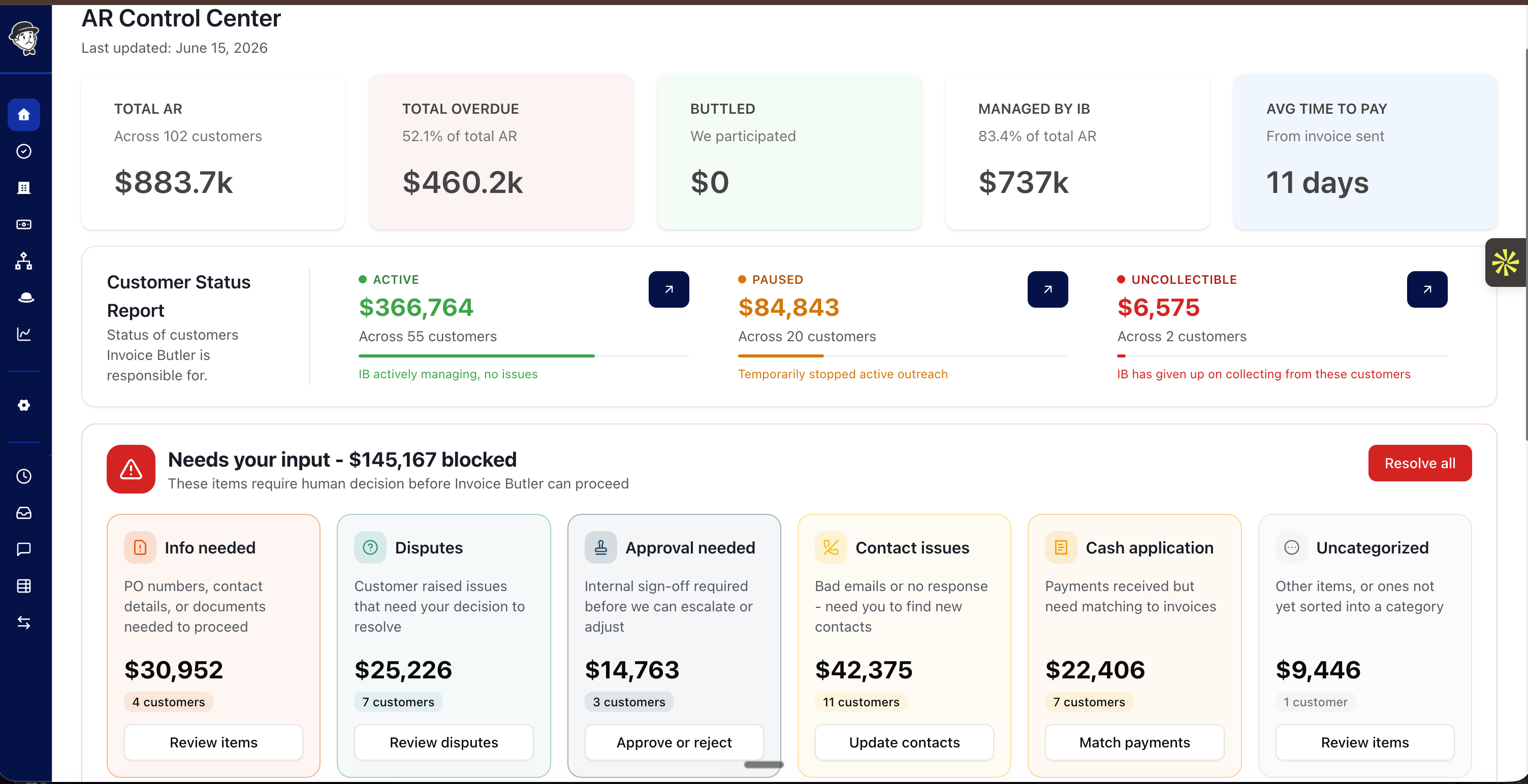
The gap between reminder #5 and the write-off.
Every aging report has them: the 90-day invoices everyone has stopped mentioning. The sequence ran. The customer stopped answering. Now what? On most teams, "now what" means a founder writes an awkward email, or worse, nobody does, because being the bad cop to a customer your CS team is renewing next quarter is a job nobody volunteers for.
Reminder software has exactly one move, send another email, and escalation is precisely the moment that move stops working. An account that has ignored five messages will ignore a sixth; the situation needs a different person, a different channel, or a different level of seniority. Tools can't make a phone call, read whether an account needs pressure or patience, or draft the note your CEO sends to their CFO.
So accounts drift toward the only options left: eat the loss, or hand 20-30% to a collections agency and torch the relationship on the way out. Both are failures of the middle game, the escalation work nobody had time to run.
Pressure, applied professionally, on your rules.
Invoice Butler treats escalation as a designed sequence, not a panic response. Aging accounts advance automatically through stages you control: firmer messaging, newly discovered contacts, direct phone calls from real operators who know how AP teams work, and, when warranted, prepared executive-to-executive outreach. We play the bad cop so your team can stay the partner. Every step is logged, every advance is flagged in Slack, and you can pause any account with one message.
What the Butler handles
Staged escalation paths
Define what happens at 30/60/90 days or after broken promises — then it actually happens, every time, no awkwardness required.
Operator phone calls
Real humans call AP directly. A ten-minute call resolves what ten emails couldn't, and we know who to ask for.
Contact-level escalation
Processor unresponsive? The butler moves up: controller, then finance leadership — found via Contact Discovery.
Executive escalation, drafted
When it's CFO-to-CFO time, you get a prepared brief and draft note: history, promises made and broken, exact ask. You hit send.
Judgment, not just pressure
Disputes and sensitive accounts get human handling — negotiation, payment plans — because some accounts need patience, not volume.
Full audit trail
Every step, message, and call logged per account. If an account ever does go legal or to an agency, the file is already built.
Live in under a week
Set your escalation rules
Triggers (age, broken promises, silence), stages, and which accounts or amounts require your approval to advance.
Accounts advance automatically
The butler moves each stuck account up the ladder on schedule, with full context carried between stages.
Humans handle the heavy steps
Operators make the calls and work the negotiations; you get prepared briefs for executive moments.
Resolution or decision
Most accounts pay during escalation. The few that won't reach you with a complete file and a recommendation.
Every stuck account, on a ladder. Every rung, on the record.

The 90-day bucket, turned into a process.
Common questions
How is this different from sending to a collections agency?
Agencies take 20–30%, operate scorched-earth, and you lose the customer. Invoice Butler escalates as your team — your tone, your rules, relationship intact — and the vast majority of accounts resolve before anything resembling an agency conversation.
Will escalation damage customer relationships?
Done sloppily, yes — which is why most teams avoid it and eat the aging instead. Done as staged, professional, correctly-targeted outreach, it usually improves the relationship: AP teams respect vendors who run a tight process.
Who makes the phone calls?
Real operators on the Invoice Butler team, briefed on the account, speaking as your AR function. Not offshore script-readers, not robocalls.
Can I stop an escalation?
Instantly — one Slack message. You can also require approval before any account advances past a stage you choose. Many customers gate the executive stage; few gate anything else after the first month.
What does executive escalation actually look like?
You receive a brief: amount, history, every promise made and broken, contact attempts, and a drafted note from your executive to theirs. Five minutes of your CEO's time, deployed precisely once it actually matters.
When should an account skip straight to escalation?
Onboarding usually starts with your existing 90+ bucket — that's where the fastest recoveries are. Beewise's $1M-in-30-days started exactly there.
Your 90-day bucket is full of money.
See what structured escalation recovers from invoices you'd mentally written off.
Book a demo