Table of Contents

Your debtors collection period might look fine on paper, but if it's climbing quarter over quarter, you've got a collections problem masquerading as normal business fluctuation.
Most finance teams run the calculation once and call it done, missing the real value: tracking how that number changes over time and comparing it to what customers are supposed to be paying under your terms. The formula is simple, but the context is everything.
TLDR:
- Average debt collection period shows how many days it takes to collect payment after a credit sale
- Calculate it by dividing average receivables by daily credit sales: (Average AR ÷ Net Credit Sales) × 365
- Reducing your collection period by 10 days frees up 10 ÷ 365 of annual credit sales in working capital (roughly one fortnight's worth of revenue)
- Industry benchmarks range from 0-15 days (retail) to 60-90 days (construction)
- Invoice Butler automates follow-ups and tracks your collection period in real-time to speed up payment
What Is Average Debt Collection Period
The average debt collection period measures how many days it takes your business to collect payment after a sale on credit. Think of it as a clock that starts ticking the moment you raise an invoice and stops when the money lands in your account.
Businesses use this metric to gauge how well their credit and collections process is working. A shorter period means cash is flowing back quickly. A longer one suggests customers are taking their time, and your working capital is sitting in someone else's pocket.
You'll also hear this called the average collection period, debtors collection period, or receivables collection period. They all refer to the same calculation.
Average Debt Collection Period Formula Explained
There are two routes to the same answer, and both pull from the same ingredients on your balance sheet and income statement.
Primary Formula
Average Debt Collection Period = (Average Accounts Receivable ÷ Net Credit Sales) × 365
Average Accounts Receivable is simply (Opening AR + Closing AR) ÷ 2. For net credit sales, pull credit-only transactions from your income statement and subtract any returns or allowances. Using total revenue instead inflates the denominator and makes your collection period look shorter than it really is, which defeats the purpose of the metric.
Via Receivables Turnover
Average Collection Period = 365 ÷ Receivables Turnover Ratio
The turnover ratio itself equals Net Credit Sales ÷ Average Accounts Receivable. If you already track that number, dividing it into 365 gets you the same result without recalculating from scratch. Handy if your reporting already surfaces the turnover figure.
Step by Step Calculation With Real Examples
Take a B2B company wrapping up its fiscal year with these numbers on file:
Step one: average the receivables. ($120,000 + $135,000) ÷ 2 = $127,500.
Step two: apply the formula. ($127,500 ÷ $1,011,000) × 365 = 46 days.
That single number tells a story. If this company's payment terms are Net 30, customers are paying roughly 16 days late on average. For cash flow planning, those 16 days are far from trivial. The business is effectively carrying six extra weeks of outstanding receivables beyond what its terms require. Budget for that gap, or start tightening follow-ups before it quietly eats into your working capital.
Average Collection Period by Industry Benchmarks
Payment terms vary widely across sectors from 0 days in retail to 90 days or more in construction, so what counts as a healthy collection period depends entirely on your industry.
Here are typical average collection period ranges by industry:
- Retail and e-commerce tend to sit between 0 and 15 days, since most transactions are point-of-sale or card-based with near-immediate settlement.
- Professional services (accounting, legal, consulting) commonly run 30 to 45 days, reflecting standard net-30 invoice terms with occasional late payers.
- Manufacturing and wholesale typically fall between 45 and 60 days, as large buyers often negotiate extended payment windows.
- Construction frequently exceeds 60 to 90 days, given project-based billing cycles and contractual retention clauses.
- Healthcare sits in a wide range, often 40 to 65 days, depending on insurance reimbursement timelines.
Your benchmark matters. Comparing your collection period against your own industry average tells you far more than comparing it against a general target.
Why Lower Collection Periods Drive Better Cash Flow
Every day a payment sits uncollected, that cash is unavailable to your business. It can't cover payroll, fund inventory, or pay down a credit line. It's just frozen.

The math follows directly from the formula. Daily revenue exposure = Net Credit Sales ÷ 365. Shaving 10 days off your collection period frees up (Net Credit Sales ÷ 365) × 10 in working capital. You can verify this with your own numbers in seconds.
For a company doing $1 million in annual credit sales, that's roughly $27,400 unlocked per 10-day improvement. At $5 million in sales, it's nearly $137,000. No new customers required, no extra cost.
Finance leaders often chase growth to improve cash position. Collecting faster gets you there without adding a single new invoice to the mix.
How to Interpret Your Collection Period Results
Three comparisons make a collection period number meaningful.
Start by stacking it against your payment terms. If you offer Net 30 but collect in 50 days on average, that 20-day gap points directly to a collections process problem. Next, track it over time. A rising figure quarter-over-quarter often means follow-up discipline is slipping, or your credit mix is shifting toward slower-paying customers.
Third, ask whether a high figure is intentional. Some businesses deliberately extend credit terms to win larger clients, making a longer period a conscious trade-off instead of a failure.
That last distinction matters. Not every high number demands action. Some do.
Common Mistakes When Calculating Collection Period
Three errors show up repeatedly, and each one skews the result in a different direction.
- Including cash sales in the denominator makes your collection period look shorter. Cash transactions settle immediately and have no bearing on how quickly you collect credit-based receivables. Use net credit sales only.
- Mixing time periods distorts the average. If your AR balance is year-end but your sales figure only covers six months, you're comparing mismatched windows.
- Skipping returns and allowances overstates your sales figure. Net them out before dividing, or the denominator is inflated and your collection period appears artificially low.
Each mistake produces a number that looks fine on paper but misleads any decision built on it. The fix is consistent inputs: credit sales only, matched time periods, and revenue net of returns.
Proven Strategies to Reduce Your Average Collection Period
Reducing your average collection period comes down to five specific actions: sending invoices on time, offering early payment incentives, following up before due dates, tightening credit terms, and removing payment friction.
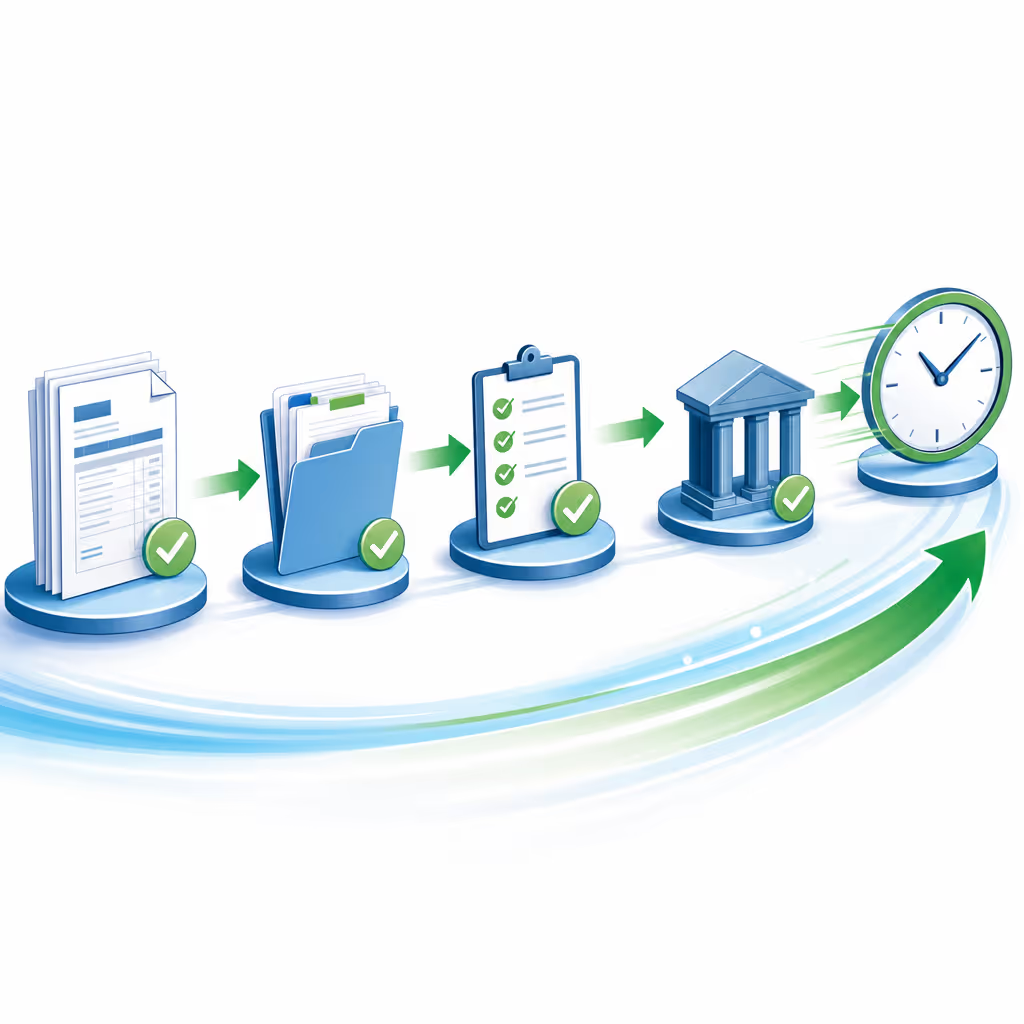
- Send invoices immediately after delivering goods or services, not at the end of the week or month. Every day you delay is a day added to your collection period before the clock even starts.
- Offer early payment discounts (2/10 net 30 is a common structure) to give customers a financial reason to pay ahead of schedule.
- Follow up proactively. A polite reminder before the due date outperforms a chase after it.
- Review your credit terms regularly and tighten them for customers who consistently pay late.
- Accept multiple payment methods so customers have no friction when they are ready to pay.
Automating Collections to Improve Your Metrics With Invoice Butler
Chasing overdue invoices by hand is exhausting, and every day you spend doing it manually is another day your average collection period creeps upward. Invoice Butler automates the whole process, sending reminders at the right intervals so you collect faster without the awkward back-and-forth.
Here is what that looks like in practice:
- Automated follow-up sequences go out on a schedule you set, so no invoice slips through because someone forgot to chase it.
- Real-time reporting shows your average collection period at a glance, so you can spot a deteriorating trend before it becomes a cash flow problem.
- Customisable reminder tones let you stay professional with your best clients while being firmer with persistent late payers.
Fewer days outstanding, less admin, healthier cash flow.
Final Thoughts on Accelerating Your Receivables
Knowing your average debt collection period is the first step, but bringing that number down is where the real benefit lives. Every day you trim off your collection cycle means more cash available for payroll, inventory, or growth without borrowing a penny. If you're ready to automate the follow-up work and stop letting invoices age on your books, schedule a quick chat to see how Invoice Butler fits into your current workflow. You'll collect faster without the awkward phone calls or spreadsheet chasing.
FAQ
What is a good average collection period for my business?
A good average collection period should match or slightly exceed your stated payment terms, ideally staying within your industry benchmark. For example, if you offer Net 30 terms, collecting in 30-35 days is healthy, but 50+ days signals a collections problem that's quietly draining your working capital.
Average collection period higher or lower better?
Lower is almost always better because it means cash reaches your account faster. Each day you shave off your collection period frees up working capital you can put to work immediately, whether that's covering payroll, funding inventory, or paying down debt.
Can I calculate average debt collection period without complicated accounting software?
Yes. You only need three numbers from your financial statements: opening accounts receivable, closing accounts receivable, and net credit sales for the period. The formula is (Average AR ÷ Net Credit Sales) × 365, which you can work out on a basic calculator or spreadsheet in under two minutes.
How do I reduce my average collection period without damaging customer relationships?
Send invoices immediately after delivery, follow up politely before the due date (not after), and offer early payment discounts like 2/10 net 30 to incentivise faster payment. Automation handles the timing and consistency so you collect faster without the awkward manual chasing that strains relationships.