Table of Contents

Most businesses compare Invoice Butler to offshore AR teams by looking at the hourly rate and stopping there. The offshore option quotes $8-15/hour, which sounds reasonable until you factor in everything the rate doesn't include: vendor selection, trial periods, 4-8 weeks of training before anyone's actually useful, ongoing management time from your team, infrastructure costs, and the replacement cycle that hits 15-25% of offshore teams every year. That last part is the killer, because when your AR person leaves, they take institutional knowledge with them. Which clients pay slow, which contacts matter, which escalation path worked last quarter. All gone, rebuilt from scratch while your receivables age.
TLDR:
- Offshore AR teams cost 1.5-2x salary when turnover hits, with 15-25% annual attrition
- Invoice Butler eliminates ramp-up delays with same-day activation and continuous coverage
- Hidden offshore costs include 4-8 week training cycles that repeat with each replacement
- AR automation delivers 390% ROI over three years with zero turnover expenses
- Invoice Butler combines AI volume handling with human AR specialists for judgment calls
The True Cost of Offshore AR Teams in 2026
The hourly rate looks great on paper. $8 to $15 per hour, maybe less if you negotiate hard. But that number rarely tells the whole story, and by the time you've added everything up, the math gets uncomfortable fast.
Here's what the quoted rate almost never includes:
- Vendor selection and due diligence, including sourcing agencies, vetting firms, and running trial periods before you commit to anyone
- Onboarding and training time, which can run 4 to 8 weeks before anyone is actually productive on your accounts
- Management overhead, because someone on your team still has to supervise, QA, and course-correct along the way
- Infrastructure costs like software access, communication tools, and security protocols that rarely come bundled in
- Ramp-up cycles every time someone leaves, which happens more often than you'd hope
That last point matters more than most businesses expect. Offshore teams see 15-25% annual turnover across the industry. For a small AR team of two or three people, that means you're statistically retraining someone every single year. Each cycle burns time, delays collections, and puts your customer relationships at risk during the gap.
There's also the softer cost of inconsistency. AR is relationship-dependent work. When contacts change, context disappears with them.
The Turnover Problem: Why Offshore AR Teams Keep Starting From Zero
Replacing an AR team member costs between 1.5 and 2 times their annual salary when you factor in lost productivity, recruiting, and retraining. For offshore roles, that cycle compounds quickly.
The deeper problem is what leaves with them. Every AR specialist who walks out the door takes the quirks of your accounts with them: which client always pays late, which contact actually approves invoices, which portal needs a specific workaround. None of that lives in a spreadsheet. It lives in someone's head.
Institutional knowledge is not transferable by default. It has to be rebuilt, one invoice at a time, while your collections slow down and your customers notice the difference.
New hires start from zero. They send the wrong tone to a sensitive account. They miss the escalation path that finally worked last quarter. You've paid once to build that knowledge, and now you're paying again.
How Invoice Butler Delivers AR Coverage Without the Hiring Headaches
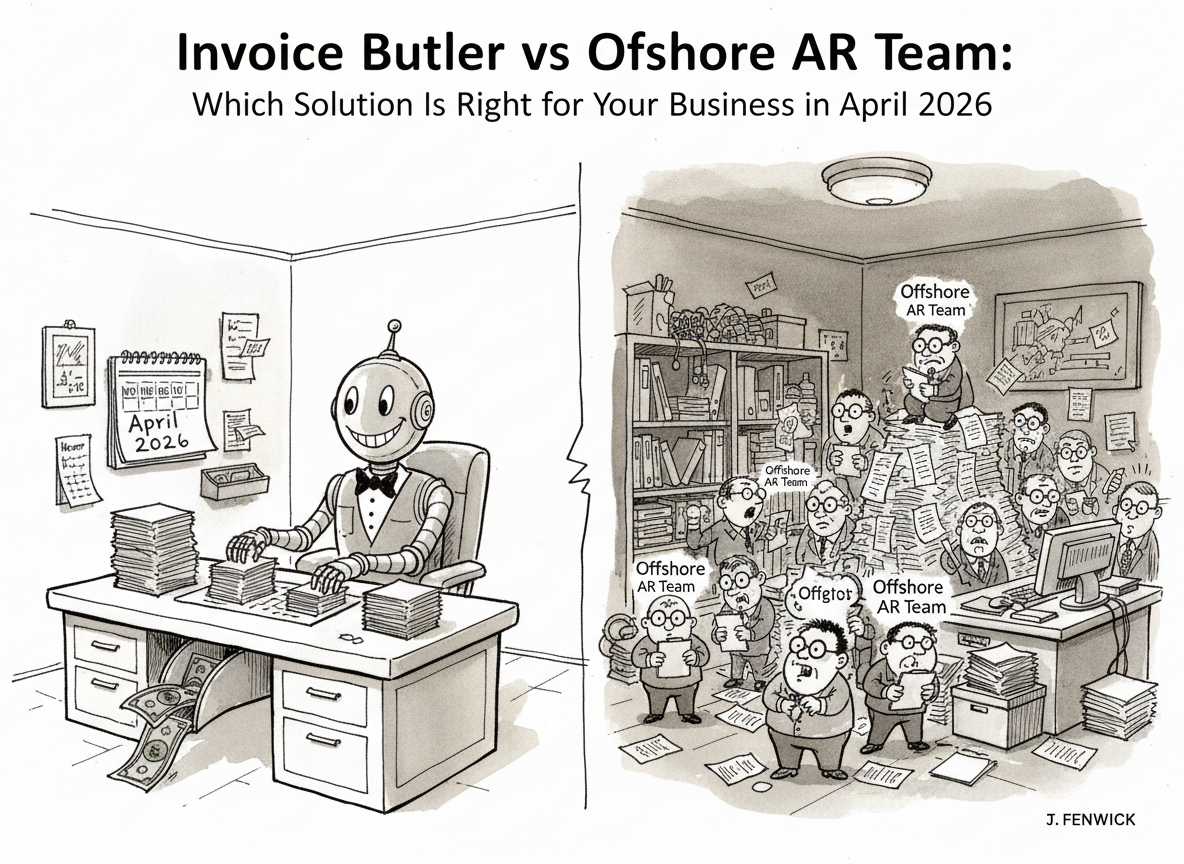
Where an offshore hire needs weeks of onboarding before they're useful, Invoice Butler is running the same day you connect your invoicing system. No recruiting, no trial periods, no explaining your accounts from scratch.
The model is straightforward: we act as your AR team. That means handling follow-ups, managing inbox replies, logging into supplier portals, escalating overdue invoices to the right contacts, and confirming when payments land. The complete workflow, beyond simple email reminders.
What makes this different from hiring is that the expertise comes with the service. You're not waiting for someone to learn your accounts. We've seen these patterns across hundreds of accounts, so we know what works and what doesn't before your first invoice goes out.
There are a few things worth calling out here:
- Same-day activation means your AR coverage starts immediately, with no ramp-up period eating into your cash flow while you wait for someone to find their feet.
- Disputed invoices and sensitive client relationships get handled by our AR specialists directly, with full context already in place.
- The service scales with your invoice volume, so a busy month doesn't mean scrambling to find extra capacity.
Customization vs. Automation: Which AR Approach Fits Your Business Model
Offshore teams offer genuine flexibility. You can train someone exactly how you want things done, build custom workflows from scratch, and adjust processes to match every client quirk. That degree of control is real, and for some businesses, it matters.
The catch? You own all of it. Every process you design, you also have to document, maintain, and re-teach whenever someone leaves. The customization is only as durable as the person holding it.
Invoice Butler works differently. The service adapts to your accounts without requiring you to build and manage the underlying system. Different clients get different tones, escalation paths, and contact strategies based on what actually works for them.
The right fit usually comes down to a simple question: do you have the internal bandwidth to manage a human process, or would you rather hand that off entirely?
- High invoice volume with limited internal oversight: automation wins on consistency and coverage across your entire receivables book.
- Industries with strict compliance requirements and unusual billing rules: you may need more hands-on control upfront, where an offshore team gives you that direct involvement.
- Growing teams without a dedicated AR hire: a service like Invoice Butler scales alongside you without triggering a recruiting cycle.
What Happens When Your Offshore AR Team Member Stops Showing Up
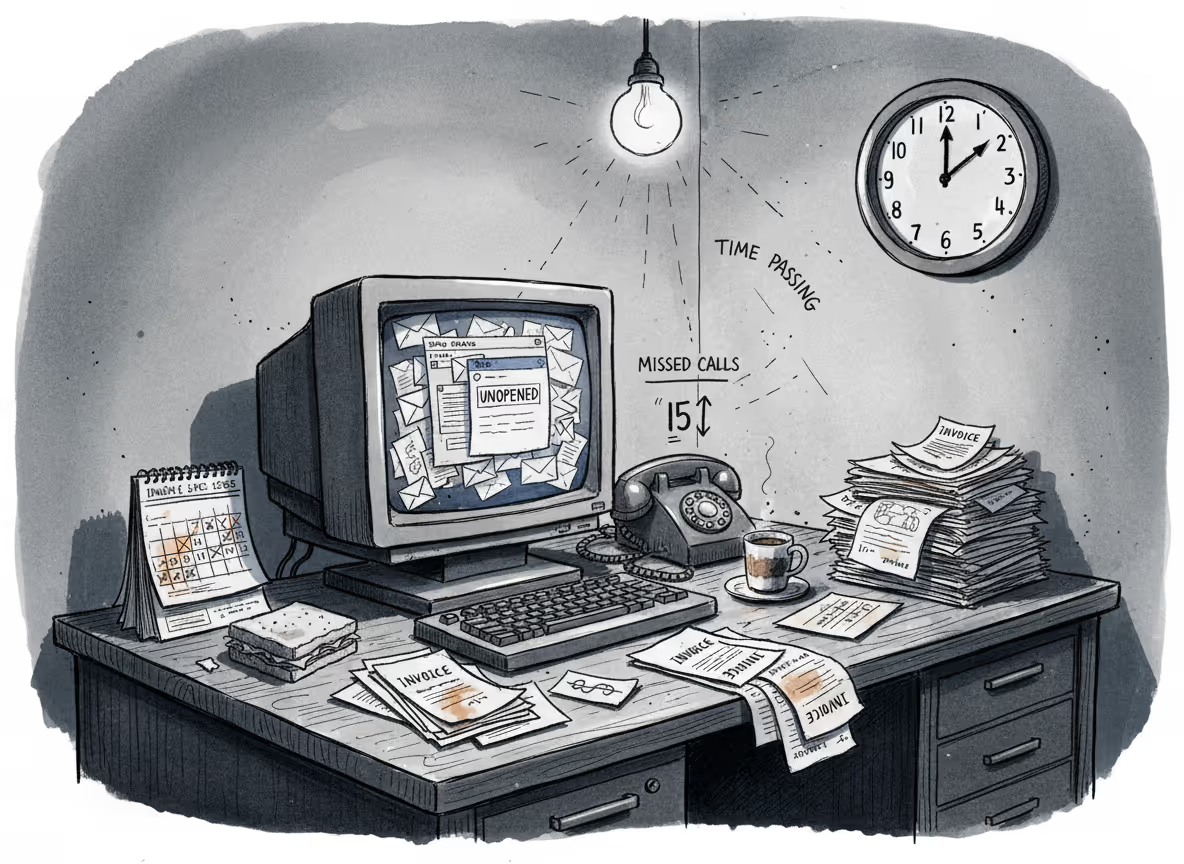
It happens more than you'd expect. An offshore AR contact stops responding on a Monday. No warning, no handoff note, no out-of-office. Just silence.
While you're figuring out what happened, invoices are sitting untouched. Follow-ups aren't going out. Customers who needed a nudge last week still haven't heard anything. And because AR work is time-sensitive, every day of silence is a day of delayed cash.
The scramble that follows is exhausting. Someone on your team picks up the slack temporarily, your vendor scrambles to assign a replacement, and you start the knowledge-transfer process all over again.
There are a few ways this situation tends to play out:
- The replacement takes days or weeks to get up to speed, during which your AR queue quietly ages and your outstanding balances grow.
- Your internal team absorbs the gap informally, pulling attention away from higher-value work to chase invoices they never planned to own.
- Relationships with customers get awkward because the tone and context built up over time by your previous contact doesn't carry over to whoever steps in.
Invoice Butler has no single point of failure. The service runs continuously because it's not dependent on any one person showing up. If something needs handling today, it gets handled today. No coverage gaps, no emergency calls to your vendor, no invoices aging quietly in the background while you sort out the mess.
The Total Cost of Ownership: Offshore Team vs AR Automation Service
Three years is where the real picture comes into focus. A single offshore AR hire might look affordable month to month, but the cumulative cost tells a different story.
| Cost Category | Offshore AR Team (3 Years) | Invoice Butler (3 Years) |
|---|---|---|
| Base salary / service fees | ~$30,000 to $45,000 | Fraction of hiring cost |
| Recruitment & onboarding | $3,000 to $6,000 per hire | $0 |
| Management overhead | 5 to 10 hrs/week of your time | Minimal |
| Turnover replacement (avg. 1 to 2x) | $6,000 to $15,000 per cycle | $0 |
| Infrastructure & software access | $1,500 to $3,000 | Included |
| Productivity loss during gaps | Hard to quantify, easy to feel | None |
For context, the average US AR Specialist salary sits at $49,699 per year. Offshore roles run cheaper, but the surrounding costs close that gap faster than most people expect.
On the other side, organisations implementing AR automation have seen 390% ROI over three years in documented cases. The compounding effect matters: no turnover cycles, no retraining costs, no coverage gaps eating into your receivables.
The offshore model asks you to absorb hidden costs indefinitely. Invoice Butler's costs are predictable from month one.
Why Invoice Butler Works Best for Continuous AR Processes
AR collections has no finish line. Every month brings new invoices, new follow-ups, and the same customers who needed three reminders last quarter and will need three more this quarter. That continuity is exactly where offshore staffing struggles and where a service model holds up.
Invoice Butler carries your customer context forward indefinitely. The system knows which accounts pay slow and contact details, and which escalation path worked last time. That knowledge compounds over time, instead of walking out the door with someone's resignation letter.
There are two layers working together here:
- The AI side handles volume and consistency, processing invoices and sending follow-ups without fatigue or gaps caused by turnover.
- The human AR specialists handle judgment calls, the tricky situations where a scripted response would do more harm than good.
Together, they cover the full cycle without you managing either one. If your AR is a one-time cleanup project, offshore help might do the job. But if it runs every single month, you want something built for continuity.
Final Thoughts on the Real Cost of Offshore AR
Offshore hiring and AR automation services solve different problems. Offshore teams offer customization and direct control, while Invoice Butler gives you full AR coverage without recruitment cycles, turnover gaps, or ongoing management overhead. Your collections keep running, your context carries forward, and the service scales with your business. We're happy to walk you through how it works for your business.
FAQ
What's the biggest hidden cost of offshore AR teams that companies miss?
Turnover. With 15-25% annual staff turnover rates, you'll statistically be retraining someone every year on a small team, and each replacement costs 1.5 to 2 times their annual salary when you factor in lost productivity and knowledge transfer.
Can I run AR collections without managing people?
Yes. Invoice Butler acts as your AR team, handling the entire collections workflow (follow-ups, inbox management, supplier portals, escalations) without you needing to hire, train, or supervise anyone.
How long does it take to start collecting with Invoice Butler vs hiring offshore?
Invoice Butler activates the same day you connect your invoicing system. Offshore hires typically need 4 to 8 weeks of onboarding before they're productive on your accounts.
Offshore AR team vs AR automation service: which has lower total cost?
AR automation delivers lower total cost over time. Offshore teams carry hidden costs (recruitment, turnover replacement, management overhead, infrastructure) that compound over years, while automation services include everything in predictable monthly fees with no coverage gaps.
What happens to customer relationships when your offshore AR contact leaves?
Context disappears with them. The new replacement starts from zero. They don't know which client always pays late, which contact approves invoices, or which portal needs specific workarounds, so your collections slow down and customers notice the difference.